Daily intelligence brief / 06:40 UTCMonitoring active
Source-backed intelligence for your stack
The briefing arrives before the surprise.
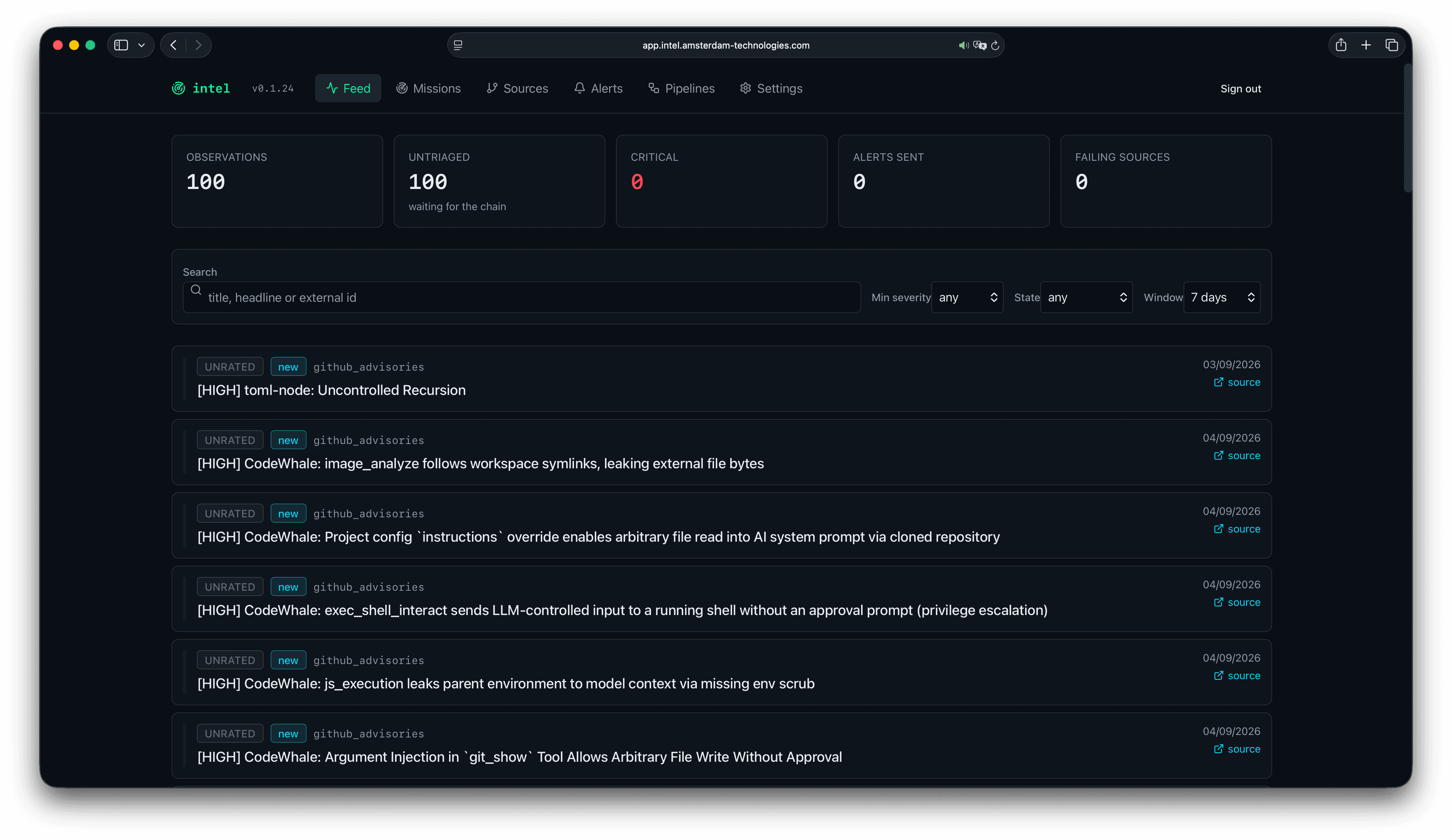
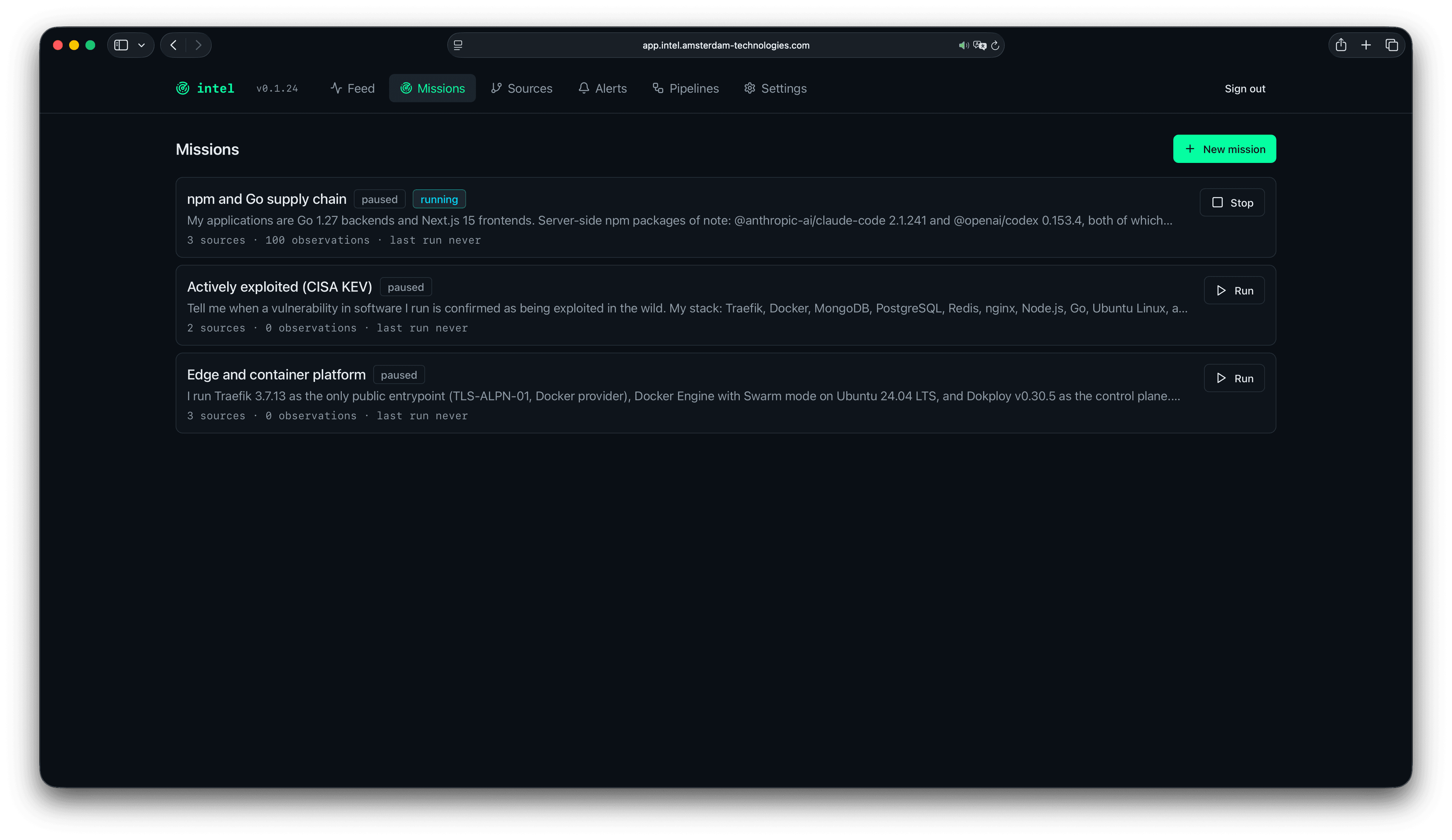
intel monitors the sources that publish first, records exactly what changed, and asks a narrow agent chain whether it matters to your versions. Every judgement keeps its evidence.
Collection is deterministic. Only judgement uses a model.
Most “AI monitoring” puts the model at the front and lets it choose what to look at. That makes monitoring probabilistic, which is the one thing an alerting system cannot be. intel does it the other way round.
01
Mission
what you care about
02
Source
where it is published
03
Observation
what changed
04
Verdict
whether it matters
05
Alert
who hears about it
Cost tracks the change rate, not the poll rate
Polling every source every minute costs the same as polling hourly, because collection issues conditional GETs and nothing else. The model runs on deltas, so a quiet week is a cheap week — not a week of paying to be told nothing happened.
A missed release is impossible, not improbable
A collector either fetched or errored, and an error is recorded and retried with backoff. Nothing decides what is worth looking at, so nothing can decide wrongly. Deduplication is a unique index, not an application-level guess.
The model does one narrow job
It reads a single changed item against your stated objective and answers a typed schema. That is a job a cheap, fast model does reliably — and one you can audit afterwards, because every step’s prompt and output is stored.
Evidence desk / 02
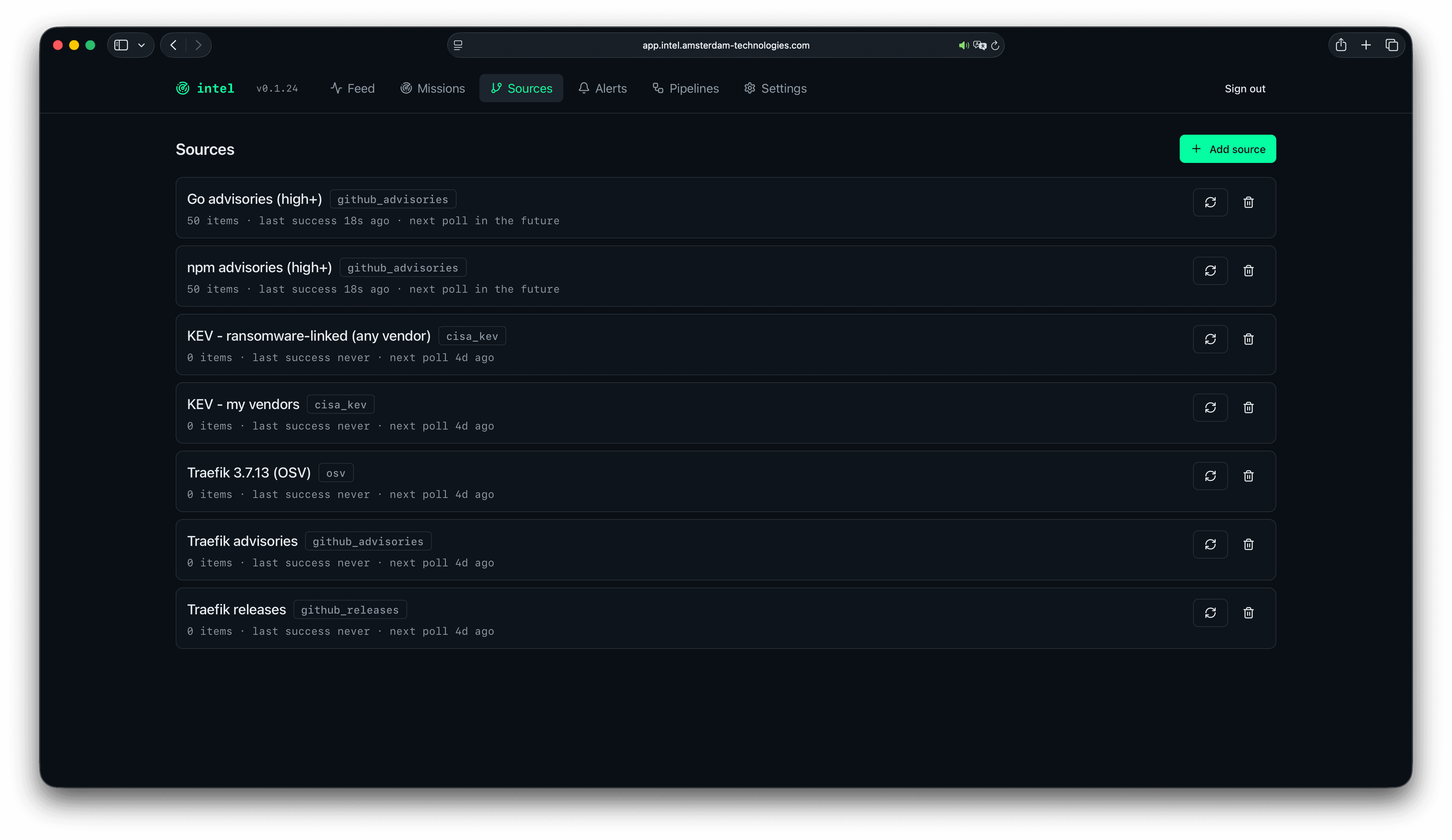
Nine source columns. Every change attributable.
Every collector issues conditional requests and stores a cursor, so a poll that finds nothing costs one 304. Deduplication is a unique index on (org, source, external_id) — a database guarantee, not a race between two concurrent polls.
github_releases
GitHub releases
Watches releases.atom for any repository. No token required.
github_advisories
GitHub advisories
The GHSA database, filtered to the ecosystems and packages you run.
github_dependabot
Dependabot alerts
Your own repositories’ open alerts. Needs a PAT with security_events.
osv
OSV
Open Source Vulnerabilities, queried per ecosystem and package.
nvd
NVD
The NIST corpus, walked by last-modified window so a backlog is worked through rather than skipped.
cisa_kev
CISA KEV
Known Exploited Vulnerabilities. Inclusion means exploited in the wild now, not merely scored highly — the best signal per request in the tree.
feed
RSS / Atom
RSS 2.0, RSS 1.0 and Atom. Categories become labels, so alert routes can match on them.
hackernews
Hacker News
Via Algolia, one request per poll. Score and comment count are kept out of the hash, so a story does not re-alert as it climbs.
webdiff
Page diff
Any URL, narrowed by CSS selector, with optional JavaScript rendering for pages that need it.
Monitoring room / 03
Follow the evidence from observation to verdict.
Try the shipped three-step shape with browser-local sample data. Change the minimum severity and the deciding gate stays visible; no request leaves this page.
Advisory triage
Interactive sample · runs locally
Resolving the first advisory
Sequence paused
STEP 01
Resolve context
Add the affected range, fixed release and local version before judgement begins.
Package
edge-proxy
Installed
3.4.1
Fixed in
3.4.3
The installed release is in the affected range and the service is internet-facing.
Processing
Pending: context is being resolved before either gate can run.
In a real run, every step stores its prompt and typed output. This demo illustrates the gate order with fixed sample inputs; it does not run a model or create an alert.
Dispatch desk / 04
An alert carries the reason it interrupted you.
A muted monitoring system is worth less than none, because it also carries the belief that you are covered. Every control here exists to keep the signal-to-noise high enough that the alerts stay worth reading.
criticalhighmediumlownone
01critical
Internet-facing package is inside the affected range
ntfy · immediate02high
Known-exploited CVE matches a monitored dependency
email + webhook03medium
Vendor release changes a watched configuration default
daily digest
Severity routing
Each route carries a minimum severity. Critical goes to your phone; medium goes to a daily digest; low is recorded and never interrupts anyone.
Quiet hours
Per route, in your timezone. Anything that arrives inside the window is held rather than dropped, so nothing is lost to a night you chose not to be woken.
Cross-source deduplication
The same CVE from NVD, OSV and a vendor feed is one alert with a dedup key, not three. A repeat inside the cooldown is a recorded suppression you can see, not silence.
Digests
A send time with minute granularity per route. The hour-windowed dedup key makes a double tick a suppression rather than a duplicate notification.
Retries that are real
A failed delivery is retried on a sweep, so a transient ntfy or SMTP outage is not permanent silence for every alert that landed during it.
Three channels
ntfy for push, SMTP for email, and a signed webhook for anything else. A route can use more than one.
Model Context Protocol
Ask it from wherever you already work.
intel serves an MCP endpoint, so an agent in your editor can query what you are watching without you opening a dashboard. Thirty-five tools, each gated by the scope on the API key you mint — a read-only key cannot create a mission, and a key without alert:send cannot make your phone buzz.
“What changed in my stack since Friday?”
“Is this CVE in anything I run?”
“Show me every verdict that produced a critical alert this month.”
You pay us for the platform. You pay your model provider for the tokens.
Your key, your bill
Add a Claude subscription token or a Gemini API key in Settings. Chains run against your account, so nothing here marks up your inference or caps it at a tier boundary.
Sealed at rest
Credentials are encrypted with AES-256-GCM under a key held only in the process environment, so a database copy is not enough to read them. They are masked on every read and never returned to a browser.
Predictable either way
Because the model only ever sees changed items, your inference bill tracks how much your watch list actually moves — not how many sources you added or how often they are polled.
Pricing
One tier. Everything in it.
No source caps, no mission caps, no per-seat pricing. The plan buys the platform; model usage is billed to your own provider account, so this number does not move with how much you watch.
Pro Monthly
For teams who need to know before the advisory does
 intel