Solution Whitepaper | Amsterdam Technologies
intel: Agentic Intelligence Gathering and Alerting with Deterministic Collection and LLM Judgement
Modern infrastructure relies on an expansive supply chain of open-source components, commercial software, and third-party dependencies. Tracking the security…
The Problem
Modern infrastructure relies on an expansive supply chain of open-source components, commercial software, and third-party dependencies. Tracking the security and stability of this stack requires monitoring a fragmented landscape of vulnerability databases, vendor feeds, GitHub repositories, and security advisories.
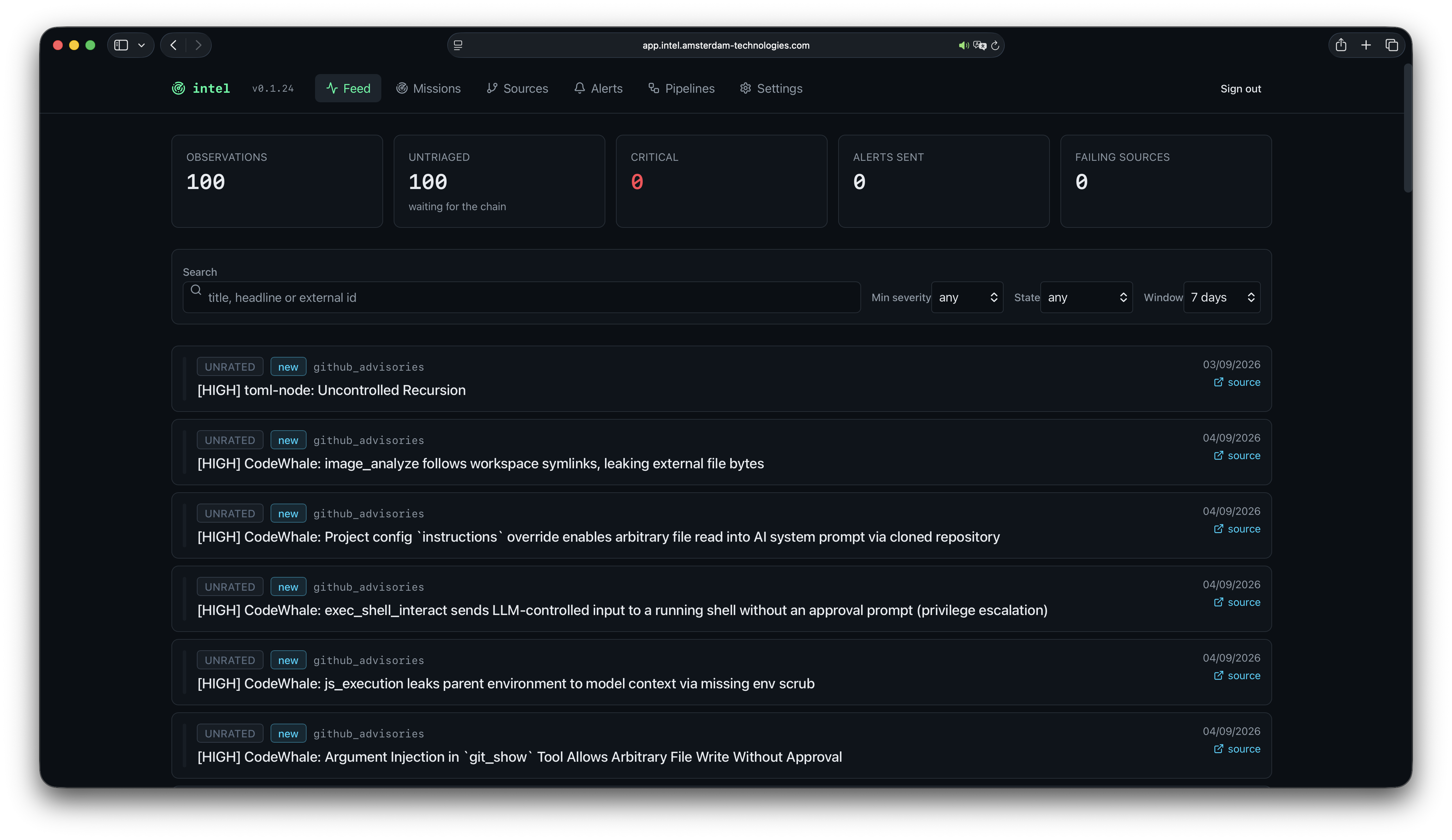
The industry standard approach forces organizations into a steep tradeoff between comprehensive coverage and signal-to-noise ratio. Traditional monitoring systems consume raw feeds indiscriminately, creating alert fatigue. When a system pages a team constantly for routine feature releases or irrelevant vulnerabilities, the system gets muted. A muted alerting system provides no protection, yet it dangerous carries the institutional belief that the organization is covered.
Recently, the market has attempted to solve this by deploying Large Language Models (LLMs) at the top of the funnel—letting AI agents search the web or scan feeds to find relevant alerts. This approach introduces severe risks. Probabilistic monitoring is fundamentally unsuited for alerting. If an LLM hallucination or an empty context window causes an agent to quietly skip an upstream security patch, the missed release is catastrophic. Furthermore, running expensive LLMs against every single item on an hourly poll rate incurs astronomical inference costs that decouple pricing from actual value.
The structural gap in the market is the absence of an intelligence system that guarantees deterministic collection without sacrificing the deep, contextual filtering capabilities of modern LLMs.
Solution Overview
intel is an agentic intelligence gathering and alerting platform designed specifically for technical teams who need to know about critical updates before the official advisory reaches them. The system operates on a foundational architectural inversion: collection is strictly deterministic, and LLM usage is reserved entirely for judgement.
Instead of letting a model choose what to look at, intel relies on deterministic collectors to poll sources, track cursors, and deduplicate items mathematically. Only when a payload's content hash actually changes does intel invoke a user-defined agent chain to evaluate the item. The agent pipeline answers a very narrow question: "Does this affect this specific infrastructure stack, and how urgent is it?"
This approach guarantees two critical outcomes. First, a missed release is impossible rather than improbable; a collector either successfully fetches a payload or reports an error—it never "decides" it saw nothing. Second, inference costs track the actual change rate of a target stack, not the polling frequency. Polling forty repositories every fifteen minutes during a quiet week costs zero tokens. By reserving LLMs strictly for evaluation, intel provides absolute collection certainty while keeping the signal-to-noise ratio exceptionally high.
Key Capabilities
Deterministic Collection Network
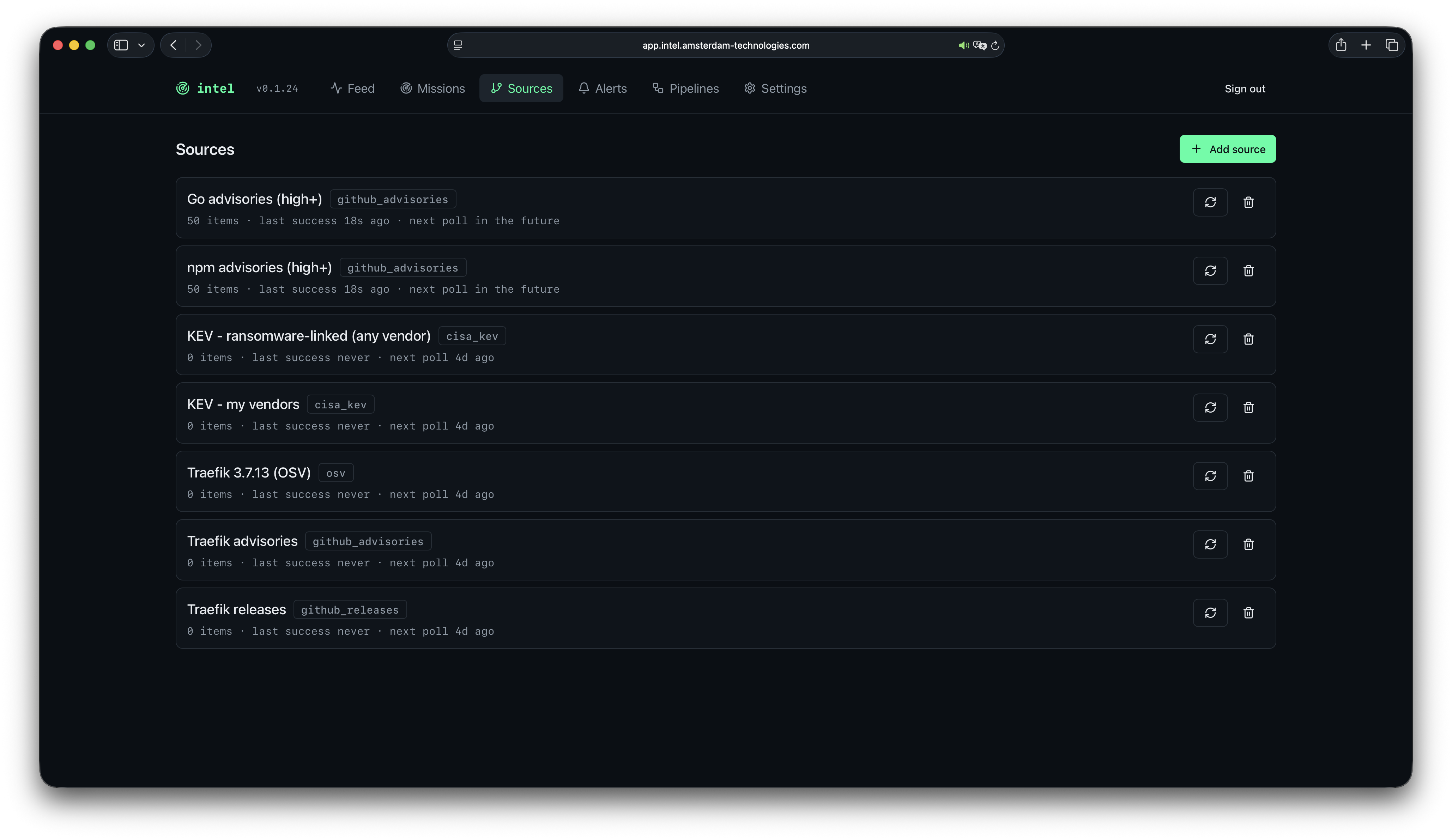
intel ingests intelligence through nine specialized collectors that cover the entire spectrum of software distribution. None of these collectors utilize LLMs. They leverage stateful cursor tracking and HTTP conditional GET operations to ensure efficient, exact ingestion.
- Vulnerability Databases: Direct integration with the Open Source Vulnerabilities (OSV) database, NIST's National Vulnerability Database (NVD), and the CISA Known Exploited Vulnerabilities (KEV) catalog. The CISA KEV integration provides the highest signal-to-noise ratio, focusing exclusively on vulnerabilities confirmed to be actively exploited in the wild.
- Ecosystem Tracking: Native collection for GitHub Releases, GitHub Advisories, and GitHub Dependabot alerts, properly scoped to the exact packages and ecosystems an organization utilizes.
- Vendor and News Feeds: Comprehensive RSS/Atom feed support, Algolia-powered Hacker News tracking, and a bespoke web-diff engine that tracks arbitrary vendor pages lacking formal feeds using CSS selectors.
Agentic Pipelines with Typed Gates
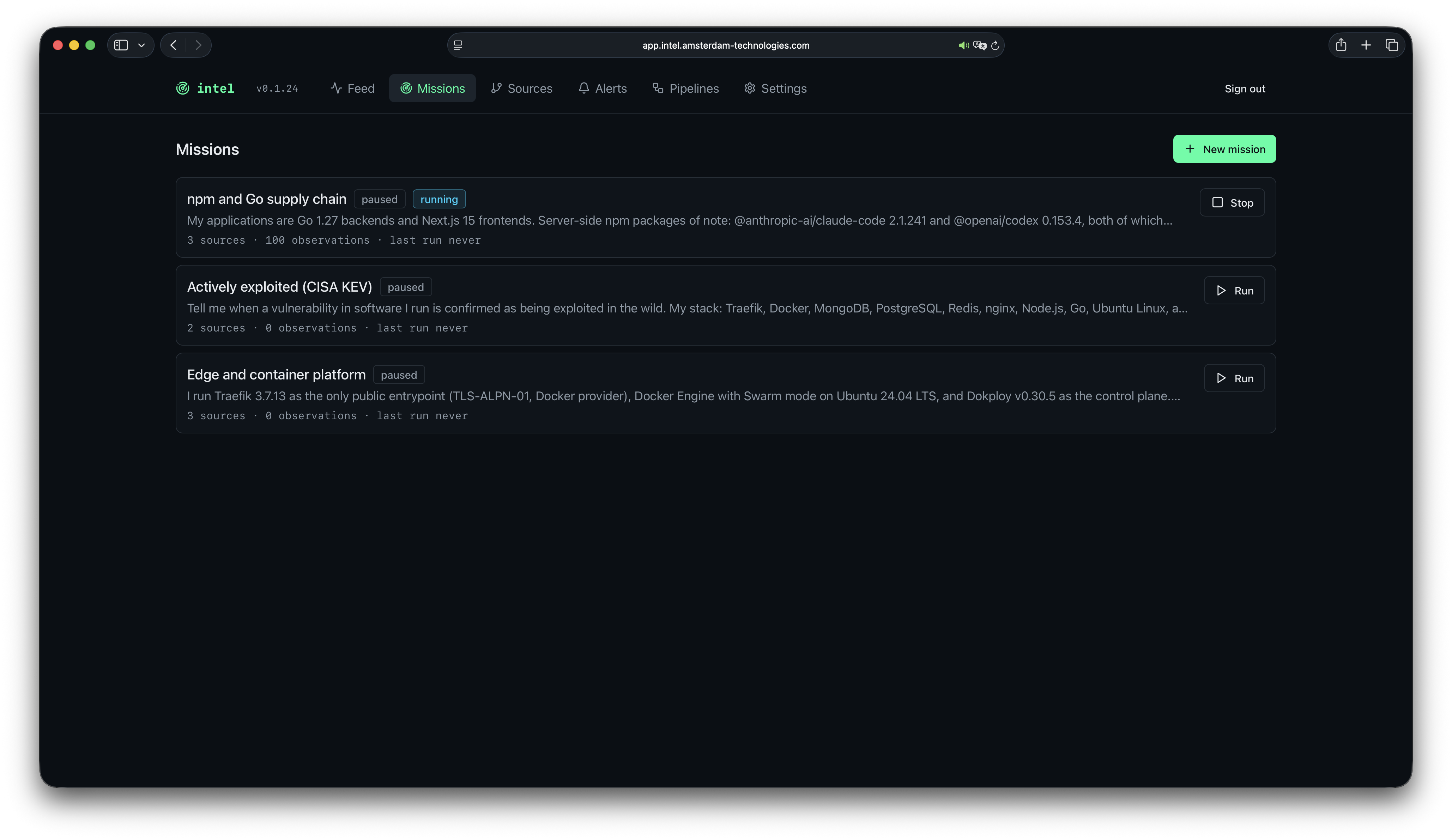
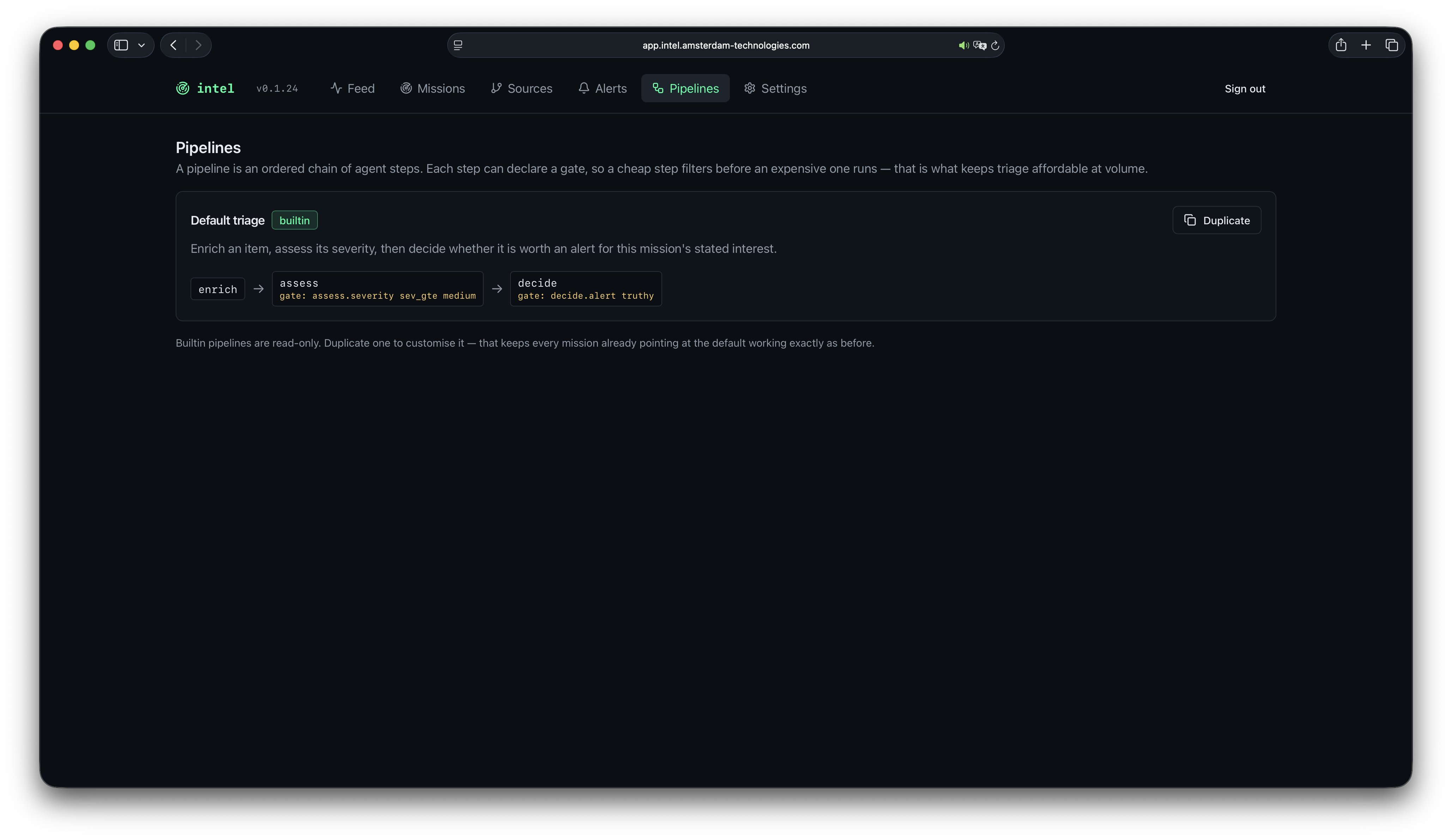
Once an item is ingested and its content hash indicates a delta, it is passed to a user-defined agent pipeline. A pipeline is an ordered set of evaluation steps, each running its own prompt, model, and toolchain.
- Enrichment and Assessment: The pipeline can fetch the source changelog, extract CVEs, and score the severity of the update against the organization's explicitly stated mission (e.g., "I run Traefik 3.1 and Go 1.27").
- Typed Gates: Between evaluation steps sit "gates"—typed, programmatic comparisons that stop the chain early. If an assessment step determines an update is only a "low" severity routine patch, a
sev_gte mediumgate will halt execution. Nothing further is spent, and no alert is sent. - Fail-Closed Architecture: Gates are designed to fail closed. If a pipeline cannot evaluate a gate due to missing data, the item is suppressed rather than alerted. This prevents a broken pipeline from paging on every observation and creating alert fatigue.
Intelligent Alert Routing and Deduplication
The ultimate goal of intel is to ensure teams keep paying attention to it. Alert routing is heavily parameterized to preserve human attention.
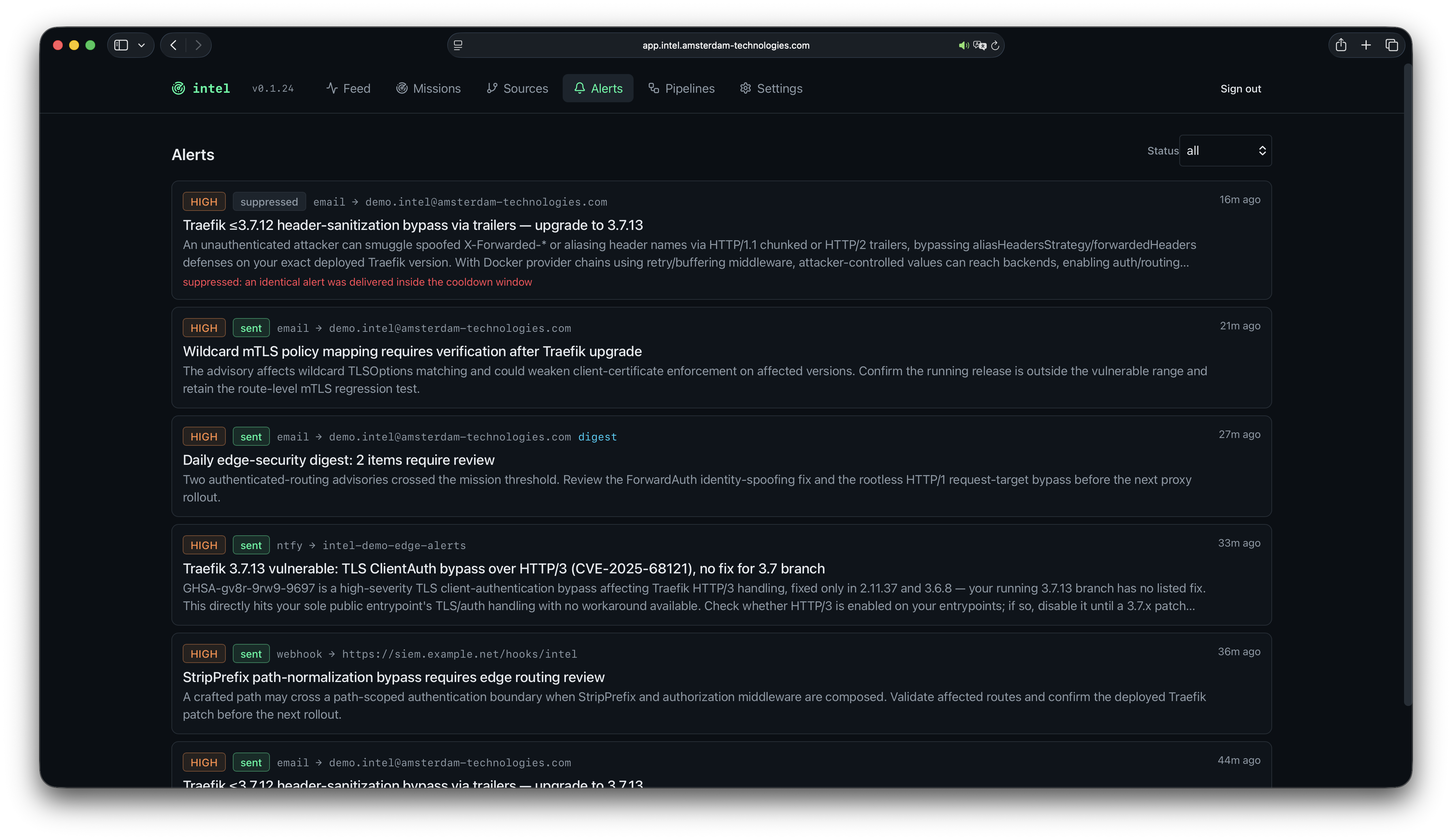
- Cross-Source Deduplication: The same CVE arriving from OSV, NVD, and a vendor feed is mathematically combined into a single alert using a deterministic deduplication key, preventing three separate pages for the same incident.
- Severity Routing and Quiet Hours: Alerts are routed based on pipeline verdicts. Critical issues can trigger immediate push notifications (via ntfy) or webhooks to paging systems. Medium severity items can be routed to email digests. Quiet hours hold alerts during off-hours, ensuring sleep is only interrupted for actual crises.
- Delivery Guarantees: A failed alert delivery is not dropped. The system retries against transport errors, ensuring transient SMTP or webhook outages do not result in permanent silence.
Model Context Protocol (MCP) Integration
intel functions not just as a background monitoring system, but as an active knowledge base accessible directly from the developer's environment.
- Contextual Querying: intel exposes an MCP server, allowing IDE-based agents to query the state of the infrastructure directly. Developers can ask their editor, "What changed in my stack since Friday?" or "Are we exposed to this new CVE?"
- Strict Access Control: The MCP integration provides dozens of scoped tools, governed by strict access boundaries. A tool with read access can evaluate the database, but alerting and write capabilities are explicitly gated, preventing an editor agent from accidentally paging a human operator.
Architecture & Technical Design
intel is built as a cloud-hosted Software-as-a-Service (SaaS) platform, utilizing a Go backend and a Next.js front-end. The architecture prioritizes data privacy, cost control, and deterministic execution.
The platform embraces a "Bring Your Own Key" (BYOK) philosophy for inference. Organizations authenticate with their own Anthropic Claude or Google Gemini subscription tokens. Because the underlying model only sees items that have mathematically changed, inference bills are directly proportional to the velocity of the monitored stack. Credentials are never stored in plaintext; intel utilizes AES-256-GCM encryption with keys held strictly in the process environment, ensuring that database snapshots cannot be used to extract tenant keys.
Data isolation is guaranteed through strict, exact-equality tenancy filtering at the database layer. Every HTTP request, internal sweeper, and MCP tool call passes through the same robust authorization gate. To prevent privilege escalation, operations that alter configurations or trigger alerts are decoupled from standard read schemas.
The system relies on asynchronous runqueues and sweeper scheduling rather than monolithic per-source cron jobs. This allows the backend to gracefully handle hundreds of concurrent watch lists, applying backoff, jitter, and deduplication logic seamlessly across multiple tenants without locking the database.
Use Cases & Scenarios
Platform Engineering and Core Infrastructure
Context: A platform engineering team maintains a fleet of Kubernetes clusters running Traefik, Docker, and specific versions of Go. Challenge: Upgrading core infrastructure components is risky, but missing a critical security patch is worse. They need to know immediately about breaking changes or CVEs in their specific version paths, but do not want to be notified about alpha releases or routine UI updates. Solution: The team configures a mission in intel detailing their exact stack versions. They connect GitHub Releases and OSV collectors. The pipeline uses an enrichment step to parse changelogs and a gate to discard anything below "high" severity. Outcome: The team is paged only when a critical patch for their exact version of Traefik drops, often hours before it reaches mainstream security newsletters.
Security Operations Center (SOC) Rapid Response
Context: An enterprise SOC tracks emerging threats. Challenge: The vulnerability landscape is exceedingly noisy. Tens of thousands of CVEs are published annually, but only a fraction are ever weaponized. Solution: The SOC configures intel to poll the CISA Known Exploited Vulnerabilities (KEV) catalog on a 6-hour interval, combining it with NVD feeds. The LLM pipeline evaluates the delta against the organization's asset inventory. Outcome: Because CISA KEV inclusion implies active in-the-wild exploitation, the pipeline routes any matches directly to the on-call security engineer via a critical webhook, bypassing normal triage delays.
Developer Workflow via MCP
Context: A senior developer is investigating a newly reported bug in an internal service. Challenge: The developer suspects a recent dependency update might have introduced the regression but does not want to manually audit a week's worth of GitHub feeds. Solution: From their IDE, the developer queries their local AI assistant connected to the intel MCP server: "Did any of our core libraries ship a breaking change this week?" Outcome: intel securely routes the query to the tenant's observation database and returns a summary of the exact dependency update, enabling the developer to pinpoint the regression instantly.
Compliance and Audit Reporting
Context: A compliance officer needs to verify that the organization is actively monitoring upstream dependencies for a SOC2 audit. Challenge: Proving that a system is monitoring effectively is difficult when the ideal state of the system is silence. Solution: The officer relies on intel's "low" severity routing. While critical alerts page engineers, low severity observations (routine patches) are quietly evaluated, gated, and stored with their full LLM prompt and verdict audit trails. Outcome: The compliance team can export a complete log of all evaluated upstream changes, proving to auditors that vulnerability intelligence is continuously gathered and systematically assessed.
Pricing & Plans
intel is delivered as a cloud-hosted SaaS platform. The pricing model covers the platform infrastructure, collector execution, and multi-channel alerting. Model inference is billed directly to your own provider via Bring Your Own Key (BYOK).
| Plan | Price | Features |
|---|---|---|
| Pro Monthly | €49 / month | 9 Collectors (GitHub, OSV, NVD, CISA KEV, etc.), Unlimited Missions & Sources, Custom Agent Pipelines with Typed Gates, Severity Routing & Digests, Alerting (ntfy, Email, Webhook), MCP Server, BYOK (Claude or Gemini). |
| Pro Yearly | €490 / year | All Pro Monthly features. Two months free with annual billing. |
| Enterprise | Custom | Unlimited usage, dedicated instance, SSO/SAML integration, SLA guarantees, on-premise deployment option, dedicated account manager. |
Pricing Philosophy: We believe you should pay for the platform's reliability and deterministic architecture, not arbitrary per-seat caps or source limits. By bringing your own model key, you pay inference costs at cost, which scale purely with the actual change rate of your infrastructure rather than the polling frequency.
Frequently Asked Questions
Is intel a probabilistic monitoring tool? No. Collection is strictly deterministic. The platform uses traditional, highly reliable polling mechanisms (conditional GETs, unique indexing, cursor tracking) to find changes. The LLM is only invoked to evaluate the content that has demonstrably changed, ensuring you never miss an alert due to model hallucination.
What happens if the LLM provider experiences an outage? If a pipeline step fails due to provider rate limits or downtime, intel records the error state and suppresses the alert rather than failing open (which would cause an alert flood). The observation remains in the queue and will be re-evaluated on subsequent sweeps once connectivity is restored.
How does intel secure my model provider keys? Your Claude or Gemini API keys are never stored in plaintext. They are encrypted at rest using AES-256-GCM. The encryption key is injected securely into the process environment and is never accessible via browser clients or database snapshots.
Can I run intel on my own infrastructure? By default, intel is a fully managed, cloud-hosted SaaS platform. For organizations with strict data residency or compliance requirements, self-hosted and dedicated on-premise instances are available as part of the Enterprise plan.
Why Amsterdam Technologies
Amsterdam Technologies operates on an engineering-first culture. We build tools that prioritize deterministic reliability, data privacy, and architectural elegance. intel embodies this philosophy by rejecting the industry trend of placing probabilistic AI at the front of the ingestion funnel. Instead, we use deterministic engineering for what computers do best—fetching and deduplicating—and reserve AI strictly for contextual judgement.
As the software supply chain becomes increasingly complex, the ability to monitor infrastructure accurately without burning out engineering teams is a critical business advantage. intel ensures you know about the vulnerabilities that matter before the advisory even reaches you.
- Website: https://intel.amsterdam-technologies.com
- Contact: support@amsterdam-technologies.com
- Company: amsterdam-technologies.com
Product screenshots